

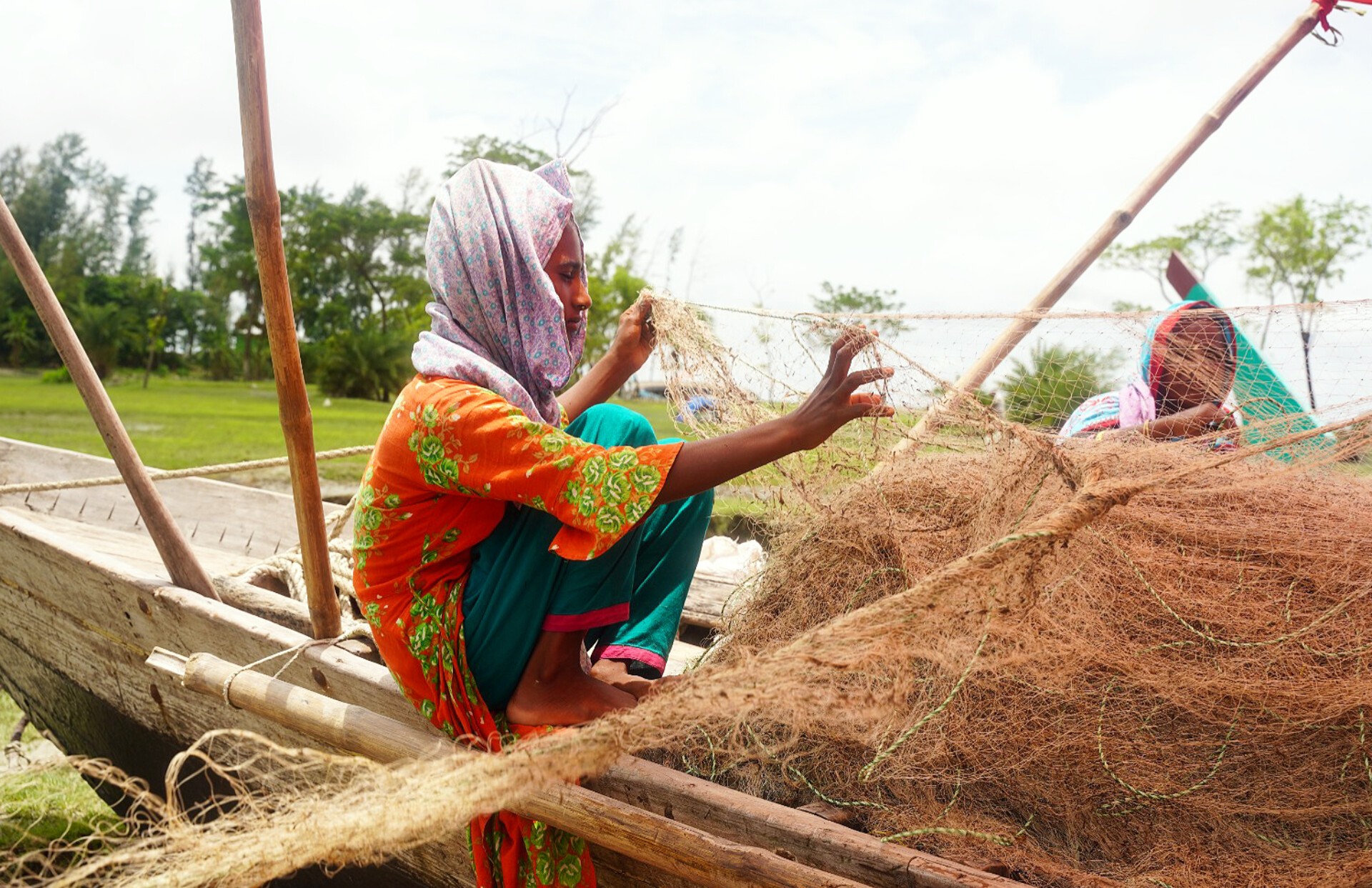
In Boyer Char, a remote coastal village in Noakhali, life is dictated by the sea. For generations, fishing has been the only means of survival, but for the families who depend on it, the sea is both a giver and a taker. The rising tides do not just wash away their earnings; they erode their dreams, their security, and sometimes even their loved ones.
"I got married when I was around 15 or 16," says Nosimon Begum, sitting on the worn-out wooden deck of her boat.
"Now, with two sons, our family of four survives on the river. The boat is our home, our livelihood, and our only refuge in hardship. What we earn in a day is spent the same day—there’s no savings, no security, just the struggle to make it to tomorrow."
Nosimon’s story is not unique—it is a shared reality among the fishing families of Boyer Char. Without land ownership, they are locked out of financial aid and government services.
"We have no land, no home—so no one considers us for a loan," explains Mojammel Hauque.
"Without land, we don’t exist on paper. That means no financial aid, no support. It’s like we have no identity at all."
While the lack of financial security keeps them trapped in poverty, the absence of basic needs like clean water and sanitation threatens their health. Many families drink saline water straight from the sea, leading to chronic illnesses. Latrines are either makeshift or nonexistent, forcing people—especially women and children—into unsafe conditions.
For mothers like Jannat Begum, the hardships go beyond financial struggles. She lost her six-year-old daughter to the river during a cyclone, an unbearable pain that time has not eased.
"She fell from the boat when the storm hit. It’s been 7 or 8 years, but I never even found her body. For us, struggle never ends—it’s just one hardship after another."
Natural disasters leave them displaced, forcing them to rebuild their fragile lives repeatedly. "We make our living by catching fish in the deep sea and selling them in the local market," says Abdul Rashid.
"But when cyclones and storms hit, our families suffer the most. We feel helpless. We dream of a Gucchogram—a place where we can live together as a community, safe from the sea’s fury."
IPAO is stepping in to turn these dreams into reality. Committed to rural development, the organization is working to improve water access, sanitation, and livelihood opportunities in Boyer Char. Through women’s empowerment programs, IPAO is helping women like Nosimon gain financial independence, so they no longer have to rely solely on the unpredictable sea. The vision of a Gucchogram—a secure, community-based housing project—is not just a hope; it is a necessity.


